GLYCOLYSIS

BY- RIA FAZULBHOY (MSIWM031)

GLYCOLYSIS (glykys = sweet ; lysis = split/breakdown)

Other name: Embden Meyerhof Parnas pathway (EMP pathway)

Introduction:

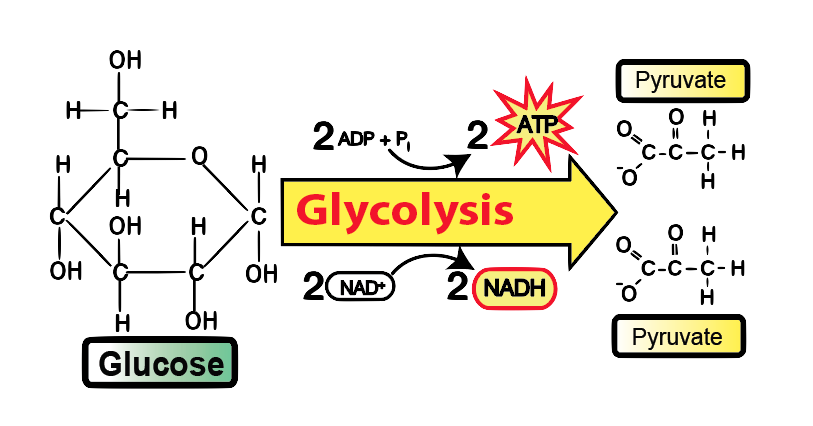
A very important pathway in the body, glycolysis is the breakdown of sugar which is glucose (a molecule containing 6 carbons – hexose) into 2 pyruvate molecules, each containing 3 carbon molecules. This process releases energy for utilization by the body in the form of adenosine triphosphate (ATP) through a sequence of enzyme reactions. Glycolysis is a catabolic pathway, i.e a pathway which involves the breakdown of larger complexes through oxidative reactions. Catabolic pathways release energy and are exogenic in nature. Glycolysis is a very important part of the metabolism of glucose and takes place in aerobic as well as anaerobic organisms and does not require molecular oxygen. This takes place in the cytosol of the cell.

Glycolysis is carried out in a sequential 10 step reaction, which are enzyme catalysed. It is represented in the following manner:

C6H12O6 + 2ADP + 2Pi + 2NAD+   →   2C3H4O3 + 2H2O + 2ATP + 2NADH + 2H+

Thus, one molecule of glucose in the presence of phosphate and adenosine diphosphate gives two 3 carbon molecules of pyruvate, along with releasing water and energy in the form of ATP.
Enzymes involved in glycolysis

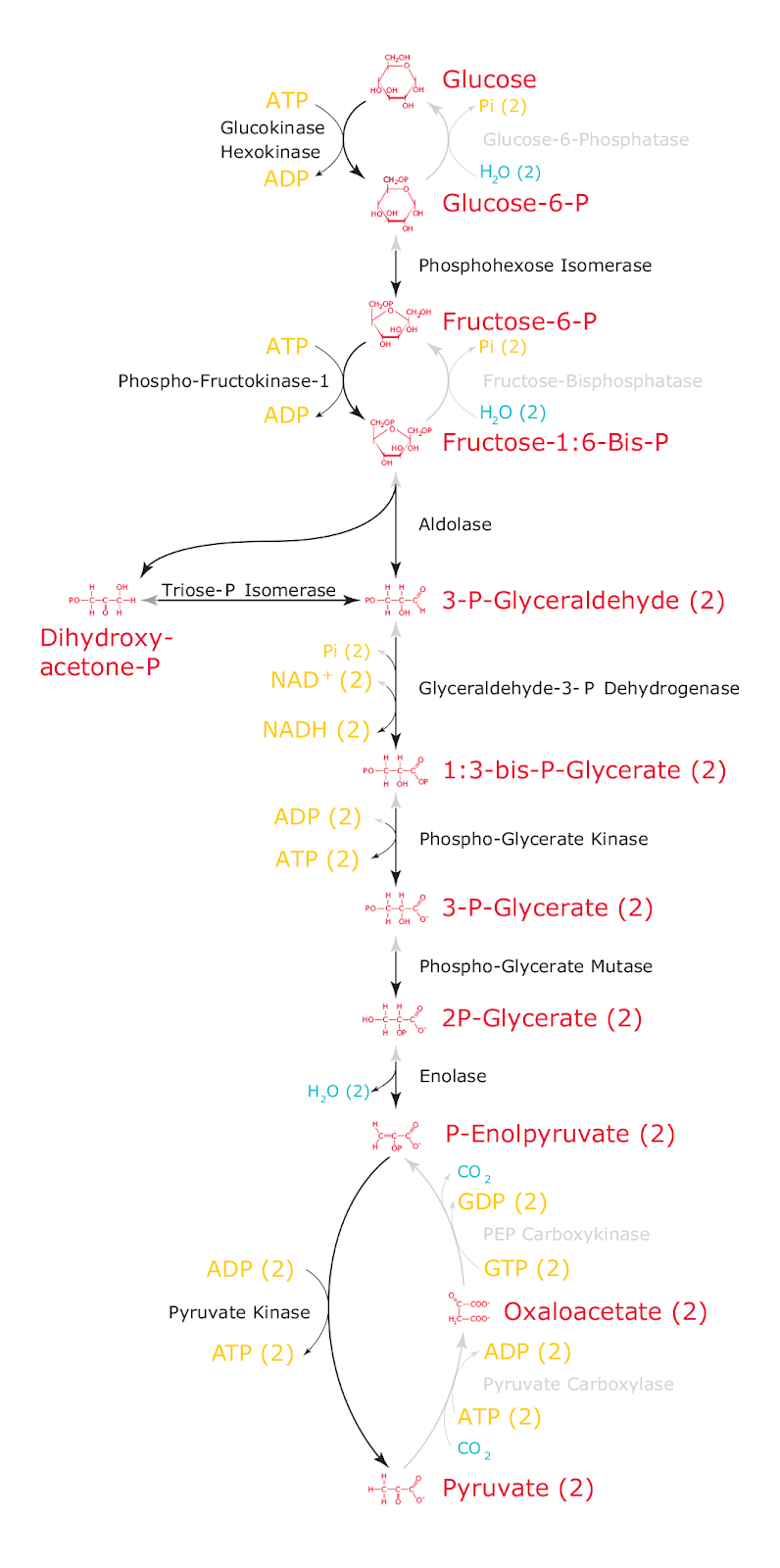
Each step of the glycolysis pathway requires the presence of an enzyme to continue the process. These enzymes include:

1) Hexokinase

2) Phosphohexose isomerase

3) Phosphofructokinase 1

4) Aldolase

5) Phosphotriose isomerase / Triose – P – isomerase

6) Glyceraldehyde 3-phosphate dehydrogenase

7) Phosphoglycerate kinase

8) Phosphoglycerate mutase

9) Enolase

10) Pyruvate kinase
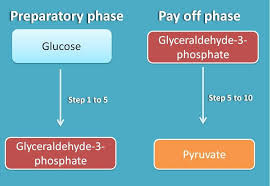
Glycolysis takes place in two steps:

  1. Preparatory phase (energy invested)
  • This phase comprises steps 1-5 of the glycolysis pathway. 
  • It is called the preparatory phase as glucose is prepared for the conversion to pyruvate by the cleaving of the hexose chain – ringed structure to form a linear structure. 
  • Energy is invested in this phase in the form of 2 ATP molecules which helps to convert glucose into 2 three carbon sugar phosphates known as Glyceraldehyde-3-phosphate, which is the final product of the preparatory phase.
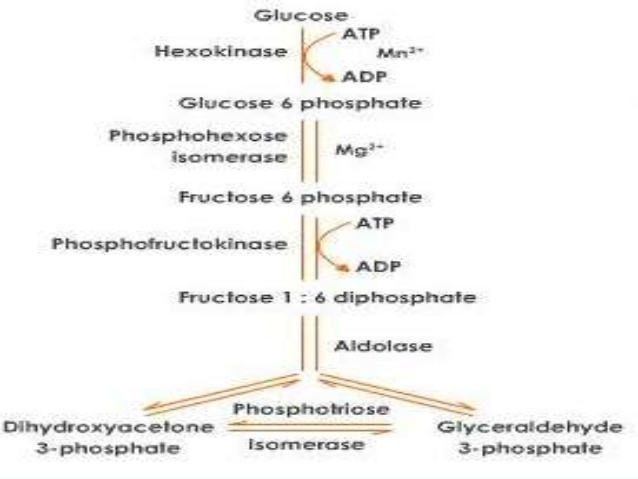
Preparatory phase of glycolysis
  1. Payoff phase (energy is released)
  • This phase is steps 5-10 of the glycolysis pathway
  • This phase is known as the payoff phase as energy is released in the form of 2 ATP molecules as glyceraldehyde-3-phosphate converts to 2 moles of pyruvate.
  • This is the final phase of glycolysis and consists of intermediates and there is a net gain of the energy-rich molecules ATP and NADH.
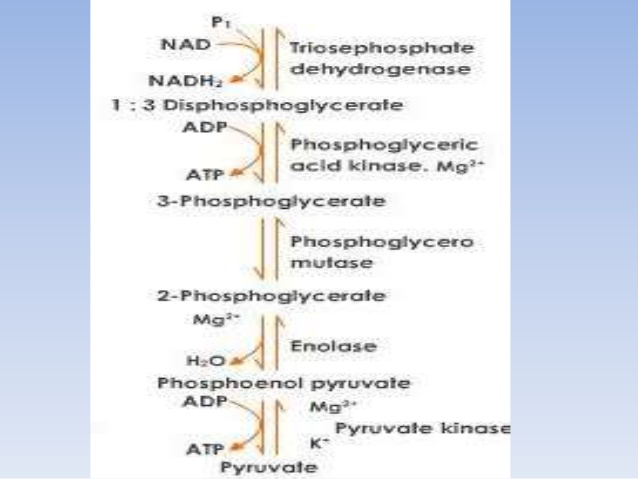
Payoff Phase of glycolysis

TO SUMMARISE:

RESULT OF GLYCOLYSIS:

  1. Pyruvate is oxidised from glucose
  2. NAD+ is reduced to NADH
  3. Phosphorylation of ADP into ATP

WHAT HAPPENS AFTER GLYCOLYSIS?

Pyruvate formed has different fates in the body, depending on the organism and also the metabolic fate, pyruvate has 3 different paths:
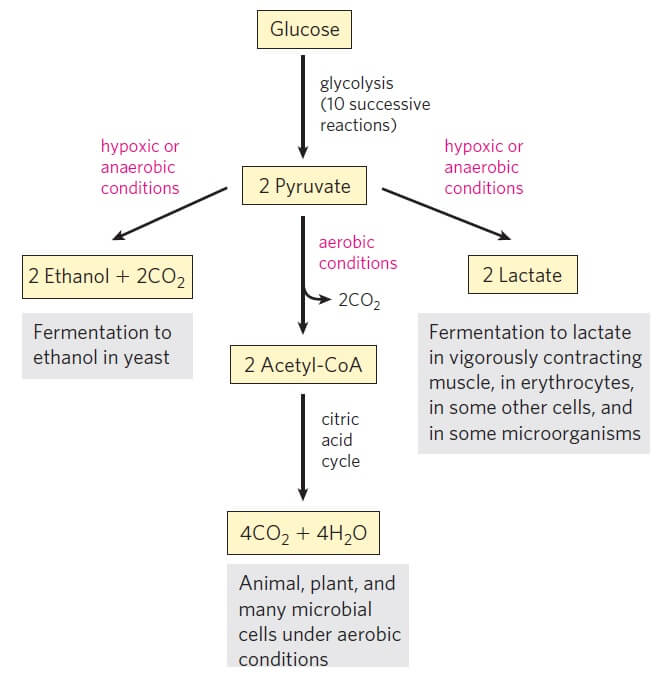
REGULATION OF GLYCOLYSIS:

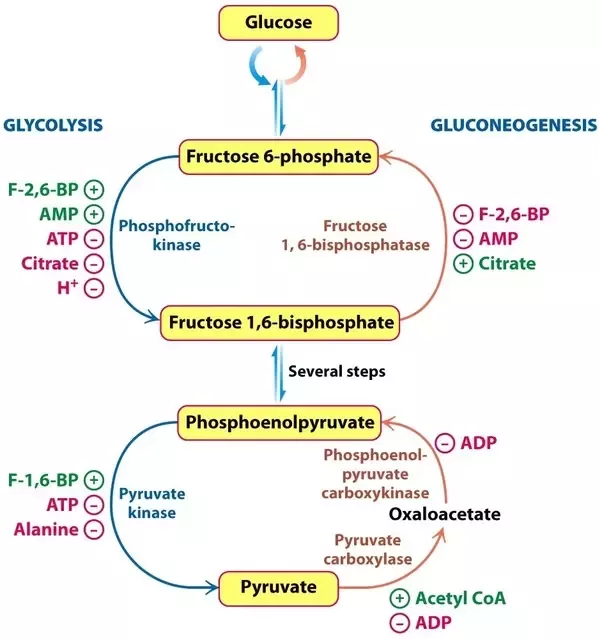
The enzymes are the most important factors that help carry the pathway forward and thus play an important role in regulation of glycolysis.

The most important of these are the 3 enzymes which carry out irreversible kinase reactions:

  1. Hexokinase/glucokinase
  2. Phosphofructokinase
  3. Pyruvate kinase
Regulation of glycolysis

Enzymes are regulated by the following biological mechanisms:

1. Gene Expression

2. Allostery

3. Protein-protein interaction (PPI)

4. Post translational modification (PTM)

5. Localization

CONCLUSION:

In conclusion, Glycolysis is an extremely important pathway which is essential for many organisms for the formation and utilisation of energy (ATP). Pyruvate formed is utilised in many future pathways in the body.

CARBOHYDRATES

BY- SREELAKSHMI (MSIWM012)

Carbohydrates are polyhydroxy aldehydes or ketones, or substances that produce such substances in hydrolysis. Most, but not all, carbohydrates have a positive effect (CH2O) n.

Stereo Isomerism:

     The presence of carbon asymmetric atoms allows the formation of isomers. Chemicals that have the same structure but differ only in localization are called stereoisomers or geometric Glucose isomers with 4 asymmetric carbon atoms with 2n (16) Isomers. n = unequal number of carbon atoms.

Epimers: a sugar that differs only in the configuration around a single carbon atom. E.g. D-glucose and D-Mannose 2. D-Glucose and D-Galactose

Diastereomers: One type of diastereomers (or geometric stereoisomers) differs in terms of “cis” and “trans”. In diastereomers, some chiral centres are similar and some are opposite. The molecule does not resemble a mirror image of its diastereomer.

D and L isomers:

Enantiomers: Enantiomers are mirror image molecules that cannot be elevated to each other. The suggestion suggests that two mirror molecules can be psychologically integrated into one object as they are integrated. Eg, D-glucose and L-glucose. When the OH group in the carbon atom adjacent to the terminal primary alcohol (carbon atom 5 in the right), sugar is a member of series D. On the left is a member of the L series. Most monosaccharaides are classified as D.

 Optical Isomerism: When a cooled light beam is transferred to a solution that reflects light performance, the part will be moved right or left depending on the type of combination present. The element that alternates the illuminated light to the right is said to be dextrorotatory and the plus (+) sign is used for designation. The rotation of the pole on the left (laevorotatory action) is marked with a minus sign (-). When an equal number of dextrorotatory and laevorotatory isomers are present, the resulting mixture has no optical functions, because the functions of each isomer overlap. That mixture is said to be a racemic mixture.

.

There are three categories of carbohydrates:

1. Monosaccharides

2. Oligosaccharides

3. Polysaccharides

Monosaccharides or simple sugars:

It contains one unit of polyhydroxy aldehyde or ketone. E.g.: Sugar, Fructose, Galactose.

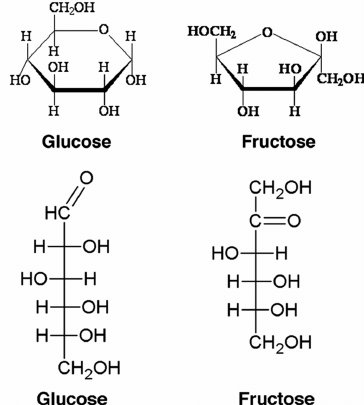
Once the group is at the end of the carbon chain (i.e., in the aldehyde group) monosaccharide is an aldose. If the group can be in another position (in the ketone group) monosaccharide is ketoses. The simplest monosaccharaides are trios-carbon trioses including Glyceraldehyde aldotriose, and Dihydroxyacetone ketotriose.

Glucose, a major source of energy for many living things. Glucose is present in both open chains and a ring form with rings forms when glucose is dissolved in water. It contains radical aldehyde as part of the structure. Group C = O in the aldehydic group has reduced concentrations and therefore lowers blood sugar. This is the most prominent monosaccharide in natural D-glucose, sometimes called dextrose. Fructose has a ketonic group as part of the structure. Group C = O in the group has reduced areas which is why it reduces sugar. Galactose is an aldohexose with reduced properties. One of the ingredients of Lactose.

Oligosaccharides: composed of short chains of monosaccharide units bound by glycosidic bonds. The most abundant are disaccharides, which have two monosaccharide units connected by glycosidic bonds. E.g., Maltose, Lactose, Sucrose.

• Maltose is also known as a sugar source made up of two sugar molecules. Maltose is formed by joining two alpha glucose molecules that meet the condensation reaction and form a glycosidic bond between molecules. It has reduced properties.

• Sucrose is a common household sugar or sugar cane and is composed of monosaccharides glucose and fructose bond. Sucrose does not contain an unknown free carbon atom.Anomeric carbons atoms of both monosaccharide units form a glycosidic bond. So sucrose sugar does not decrease. Non-reducing disaccharides are called glycosides.

Polysaccharides: Sugar polymers contain more than 20 or more units of monosaccharides called polysaccharides. E.g., Starch (Amylose, Amylopectin), Glycogen, Cellulose, Chitin. Polysaccharides are the main polymers of monosaccharaides .The polysaccharides may not be soluble or form colloidal suspensions. Starch is an alpha glucose polymer that is a mixture of two different polysaccharides.

AMYLOSE AND AMYLOPECTIN

AMYLOSE: They are long, unstable plates of sugar units. It is made up of a series of condensation reactions that include alpha glucose molecules that have been synthesized into an extended chain that forms many glycosidic bonds

AMYLOPECTIN – a very powerful polymer for glucose units. It contains an open series of alpha glucose units with branch points across all twelfth glucose. Branch points are formed when carbon 6 of the glucose molecule within an open chain forms a glycosidic bond with carbon 1 of the glucose molecule placed above the series

Glycogen

• Glycogen is often referred to as glycogen. The structure of Glycogen is almost identical to amylopectin but there are many branches in glycogen. Glucose is stored as glycogen in large mountains in both liver and bone tissue.

Cellulose:

• Cellulose is one of the most important structural polysaccharides because it is the major component of plant cell walls. Many identical chains of beta glucose units are formed and the whole chain contains hydrogen bonds between groups of OH adjacent chains.

Chitin:

• Chitin can be a polysaccharide that makes many invertebrate exoskeletons. N-acetyl glucosamine polymer in beta 1 to 4 glycosidic bonding. It is a key component of the insect and crustacean sac that protects and supports.