
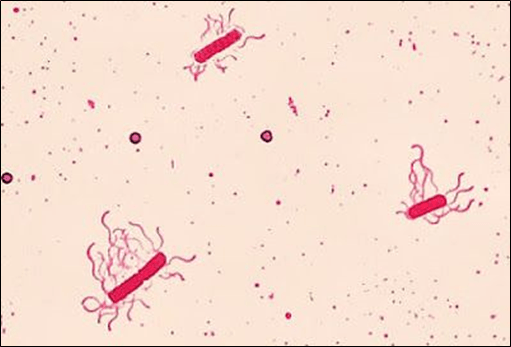
- The motility of many bacteria is due to the presence of thread like appendages called flagella.
- Flagella are a thin proteinaceous structure which is originate from cytoplasm and comes out from the cell wall.
- Types of flagellar patterns:
- Monotrichous: single flagellum at one end.
- Lophotrichous: many flagella at one end.
- Amphitrichous: flagella on both ends.
- Peritrichous: flagella all over the surface.
Principle:
- For staining of flagella, Ziehl’s carbol fuchsin is commonly used.
- Carbol fuchisn is a mixture of basic fuchisn and phenol which has great affinity towards the mycolic acids found in cell membrane of bacteria.
- In addition, the stain contains tannic acid and potassium alum used to coat and thicken the flagellum to make it visible.
Requirements:
- 18 hours old culture of proteus vulgaris
- Flagella mordant
- Ziehl’s carbol fuchsin
- Glass slide
- Dichromate solution
- 95% alcohol
- Distilled water
- Wash bottle
- Inoculating loop
Procedure:
- Take the slide and dip in dichromate solution then wash with water and rinse with 95% alcohol, pass the slide through flame and allow it to cool.
- Prepare the bacterium suspension in distilled water and incubate for 10-15 minutes at room temperature.
- Place a loop full of the sample on one of the edges of the slide.
- Tilt the slide to make the drop spread on the slide and a thin film in prepared.
- Leave the slide to air dry the smear.
- Cover the smear with flagella mordant and leave for 10 minutes.
- Wash the slide with distilled water.
- Flood the carbol fuchsin on the slide and leave for 5 minutes.
- Wash the slide with distilled water.
Results:
- Under the microscope the bacterial cell appear pink with deep stained rod, flagella with pink colour on the outer coat.
 microscopiaiwm.com
One thought on “FLAGELLA STAINING”