
BY: SAI MANOGNA (MSIWM014)
Introduction:
Fungi: Fungi are eukaryotic microorganisms that do not photosynthesize and have a cellular wall. They parasitize or live as spores of organisms. Fungi invade keratinized tissue such as the horny cell layer, hair, and nails in superficial mycosis.
1. A broad range of fungi that are commonly present in the environment cause fungal diseases.
2. These invasive fungal infections occur rarely in healthy people, but in individuals with compromised immune systems, fungi may cause severe infections.
3. In the soil and on plants and trees, as well as indoor surfaces and human skin, fungi live outdoors.
4. Millions of different fungi species exist, but it is known that only a fraction of them make people sick.
5. Anyone may get a fungal infection, such as a toenail infection or an athlete’s foot infection, but individuals with weakened immune systems are more likely to get severe fungal infections.
6. An increasing danger to human health is fungal diseases. People living with HIV / AIDS, organ or stem cell transplants, cancer patients, and hospitalized patients are vulnerable to infection, while healthy people seldom suffer from severe fungal infections.
7. Only four antifungal drugs exist, and fungal strains are emerging that are resistant to these drugs. At present, there are no licensed vaccines to prevent fungal infections.
Types of Fungal infections:
Many common fungal infections may infect the skin. Besides the skin, mucous membranes are another common place for fungal infections. Some examples of these are infections of vaginal yeast and oral thrush.
A. Candidiasis:
1. Candida is a yeast that can be found in the digestive tract, on the skin, on mucous membranes.
2. Overgrowth of these yeasts can cause the development of symptoms that occur in the mouth or throat; for example, it is called “thrush” or candidiasis of the oropharynx.


3. Usually, candidiasis in the vagina is referred to as a “yeast infection.” Overgrowth of these fungi can cause invasive candidiasis for individuals with certain risk factors, a severe infection that can damage the body’s blood, heart, brain, skin, bones, and other sections.
4. The most common type of invasive candidiasis is candidemia, a bloodstream infection with Candida, and it often affects hospitalized patients.
5. More than 20 Candida yeast species can cause human infection, but most infections are caused by Candida albicans, C. glabrata, C. parapsilosis.
6. Tropicalis, Candida auris is a newly emerging fungi species that are difficult to detect and frequently avoids multiple antifungal drugs.
B. Aspergillosis:
1. A common mold found indoors and outdoors is Aspergillus.
2. Without being sick, people breathe in various Aspergillus spores every day.
3. People with compromised immune systems or lung disorders are, however, at risk of developing Aspergillus-induced health problems.
4. Several kinds of aspergillosis range from mild to extreme illnesses. For instance, without causing infection, Aspergillus may cause inflammation of the lungs (allergic bronchopulmonary aspergillosis) or sinuses (allergic Aspergillus sinusitis). Invasive aspergillosis is a rare, severe lung or other body system infection and is a significant cause of mortality in immunocompromised people.

C. Cryptococcosis:
1. Cryptococcus fungi are present worldwide in the soil and are mostly related to bird droppings.
2. Two key disease-causing species exist: Cryptococcus neoformans and C. gattii.
3. These fungi cause infections in healthy individuals, but for people with weakened immune systems, such as those with HIV / AIDS, they can be severe.
4. The infection happens typically when others inhale the fungus. The lungs and the nervous system are the most common sites of infection. The most prevalent cause of meningitis in adults is cryptococcal meningitis, a leading cause of death in people with HIV / AIDS.

D. Coccidioidomycosis (Valley Fever):
1. It is an infection caused by the Coccidioides immitis and C posadasii fungi, also referred to as Valley Fever. These are soil-dwelling fungi found in arid, desert-like conditions.
2. The fungi were discovered recently in south-central Washington. Infection usually happens by breathing Coccidioides spores into the lungs, and healthy individuals are at risk of Coccidioides infection, unlike most severe fungal diseases.
3. In California and Arizona, the highest rate of infection has taken place. These states registered more than 11,000 Valley Fever cases in 2016 to estimate 15 to 30 percent of community-acquired pneumonia.
4. Valley Fever can, however, be under-reported due to low testing rates. A self-limiting, moderate, flu-like disease can range from Valley Fever to severe disseminated infection that may require life-long therapy.

E. Athlete’s Foot:
1. Athlete’s foot infection is also called tinea pedis, which occurs on foot.
2. In wet, moist places such as shoes, socks, swimming pools, locker rooms, and public showers, the fungi grow best.
3. In summer and hot, humid climates, they are always found.
4. People who wear tight shoes, who do not change their sweaty socks, and use public baths and pools are more likely to do so.
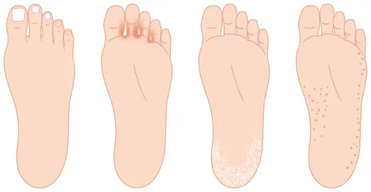
Causes: The fungi behind the foot of the athlete reside on the dead tissue of hair, toenails, and layers of the outer skin. There are four kinds of fungus which cause the infection. Trichophyton rubrum is the most common.
Symptoms: The symptoms of an athlete’s foot vary from individual to individual such as, peeling, cracking of feet, blisters, black, softened, or broken-down skin, itching, and burning sensation.
F. Ringworm:
1. This ringworm is not a worm. It is a skin infection caused by moldlike fungi that live on skin, hair, and nails’ dead tissues.
2. It can also cause infection on the scalp.
3. That is what people call an athlete’s foot when they have it between the toes and also known as jock itch if it extends to the groin.

Symptoms: A red, scaly patch or bump that itches is the telltale sign. The bump transforms into a ring- or circle-shaped patch over time. Maybe it will transform into many circles. Usually, the interior of the patch is transparent or scaly. The outside could be elevated and bumpy slightly. Ringworm appears to start as a lump or slight sore on the scalp. It may be flaky and scaly, and the contact may feel tender and painful on the scalp. It may also be noted that patches of hair are starting to fall out.
Causes: The ringworm is incredibly infectious. In any of the following forms, can capture it by:
From a different person: often, ringworm spreads by skin-to-skin touch.
From the dogs: By rubbing sparky or grooming her, when it is done, the face should be washed. It is prevalent for cows, too.
By touching things: On surfaces, clothing, towels, and in combs and brushes, the fungus that causes ringworm can linger.
From the dirt: If people work or stand barefoot in soil tainted with the ringworm-causing fungus, they might get it.
G. Jock Itch:
1. Jock itch is caused by a form of fungus called Tinea. Often known as tinea cruris, the infection is Tinea is fond of wet, damp areas such as the groin, inner thighs, and buttocks.
2. More commonly, infections occur in the summer or humid, wet climates.
3. Jock itch is a red, itchy, frequently ring-shaped rash.

Causes: jock itch is a mildly infectious, which spreads from person to person by direct or indirect contact through objects with the fungus on them.
Symptoms: Jock itch signs include; On the groin or thigh, scratching, chafing, or burning, a circular, red rash with raised edges, redness in the thigh or groin, skin that flakes, peels, or cracks.



 microscopiaiwm.com