MITOSIS- its Occurrence, Stages and Significance.


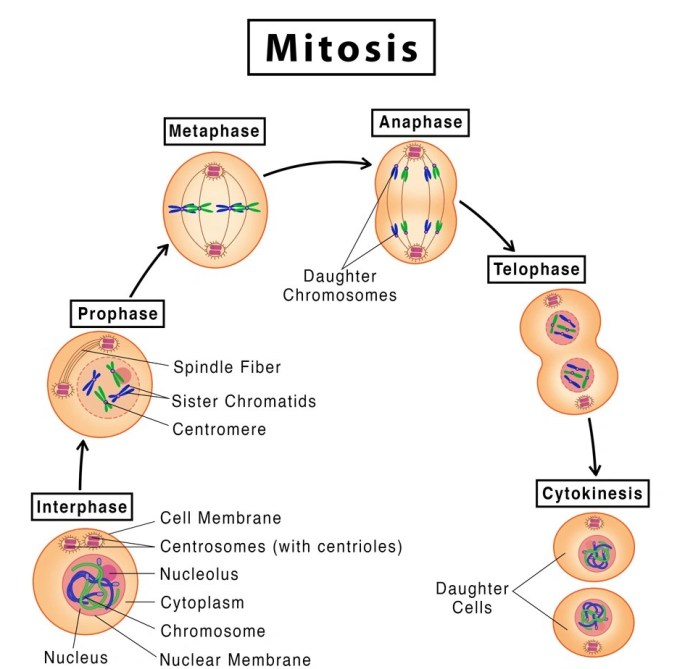
  1. Mitosis is a type of cell division that takes place in living organisms and it is commonly defined as the process of duplication of chromosomes in eukaryotic cells and distributed during cell division.
  2.  The process where a single cell divides resulting in two identical cells, each resulted cell contains the same number of chromosomes and same genetic composition similar to the parent cell.
  3. Mitosis was first discovered in plant cells by Strasburger in 1875. In 1879, mitosis is also discovered in animal cells by W. Flemming. Flemming in 1882 gave the term Mitosis.
  4. The term mitosis is derived from the Greek word such as ‘Mitos’ means thread.
  1. The mitosis takes place in somatic cells. The cells which undergo mitosis are called  Mitocytes.
  2. In plants, the mitocytes are called meristematic cells. Some of the major sites of Mitosis in plants are root apex, shoot apex, intercalary meristem, lateral meristem, leaves, embryo, and seeds.
  3. In animals, the mitocytes are stem cells, germinal epithelium, and embryonic cells. In animals, it mainly takes place in Embryo, skin, and bone marrow.
  4. Mitosis also occurs during the regeneration of the cells. The mitosis takes place for three main reasons such as growth, repair, and asexual reproduction.

NUCLEUS:

It is a membrane-bound cell organelle present in both animal and plant cells. It is the center of the cell where genetic material is stored in the form of DNA. The DNA is arranged into a group of proteins into thin fibers. During the Interphase of the cell division, the fibers are uncoiled and dispersed into the chromatin. During mitosis, these chromatin condenses to become chromosome.

 CHROMOSOME:

The chromosomes carry genetic material and they are made of DNA. The mitotic chromosomes possess two sister chromatids, they are narrow at the centromere. They also contain identical copies of original DNA. These Mitotic chromosomes are homologous, they are similar in shape, size, and location of centromere.

STAGES OF MITOSIS :

The mitosis cell division is broadly explained in two stages such

  1. Karyokinesis: Division of Nucleus. Greek ‘karyon’ means the nucleus, whereas ‘kinesis’ means movement.
  2. Cytokinesis: Division of Cytoplasm.

4 different stages that take place in Karyokinesis.

PROPHASE:

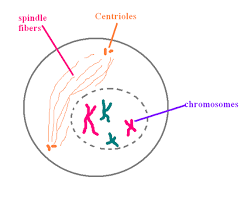
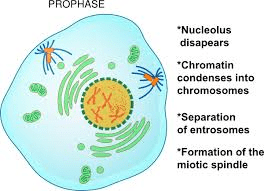
  1. The nucleus becomes spherical and the cytoplasm becomes more sticky.
  2. The chromatin slowly condenses into well-defined chromosomes.
  3. During Prophase, the chromosomes appear as a ball of wool. The chromosomes consists of two threads which are longitudinal known as chromatids.
  4. The chromosomes appear as two sister chromatids joined at the centromere.
  5. The microtubules are formed outside the nucleus.
  6. In plant cells, the spindle apparatus is formed without centriole. In animal cells, the centriole is divided into two moves towards opposite poles.
METAPHASE:

  1. Nuclear envelop breaks down into membrane vesicles and the chromosomes are set free into the cytoplasm.
  2. Chromosomes are attached to spindle microtubules through kinetochore.
  3. Nucleolus disappears.
  4. Kinetochore microtubules arrange the chromosomes in one plane to form a central equatorial plate.
  5. Centromeres lie on the equatorial plane while the chromosome arms are directed away from the equator called auto orientation.
  6. Smaller chromosomes remain towards the center while larger ones arrange at the periphery.
  7. Metaphase is the longest stage of Mitosis and takes place for about 20 minutes. It is the best stage to study the structure of chromosomes.

ANAPHASE:

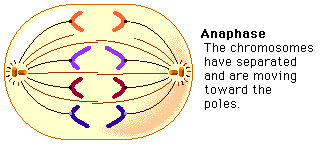
  1. Chromosomes split simultaneously at the centromeres so that the sister chromatids separate.
  2. The separated sister chromatids move towards the opposite poles.
  3. The daughter chromosomes appear in different shapes such as V-shaped(metacentric), L-shaped(sub-metacentric), J-shaped(acrocentric), rod-shaped(telocentric).
  4. The spindle fibers are attached to the centromere and pull the chromosomes to the poles.
  5. Anaphase is the shortest stage of Mitosis.
TELOPHASE:

  1. Daughter chromosomes arrive at the poles. Kinetochore microtubules disappear.
  2. Chromosomes uncoil into chromatin.
  3. Nucleolus reappears. The formation of nuclear envelope occurs around each pair of chromosomes.
  4. The Viscous nature of the cytoplasm decreases.
  5. Telophase is called a reverse stage of the prophase.

CYTOKINESIS:

Cytokinesis is defined as the division of cytoplasm.

  1. It starts during the anaphase and is completed by the end of the telophase.
  2. It takes place in 2 different methods.

a) Cell plate method: It takes place in plant cells. The vesicles of Golgi fuse at the center to form a barrel-shaped phragmoplast. The contents of the phragmoplast solidify to become a cell plate, this cell plate separates the two daughter cells.

b) Cleavage or cell furrowing method: It takes place in Animal cells. In this method, a Cleavage furrow appears in the middle, which gradually deepens and breaks the parent cell into two daughter cells.

  1. Mitosis is called as an equational division in which daughter cells produced are identical.
  2. It maintains the constant number of chromosomes and genetic stability in somatic and vegetative cells of the living organisms.
  3. It helps to increase the cell number so that zygote transforms into a multicellular adult.
  4. Healing wounds takes place by Mitosis.
  5. It helps in asexual reproduction.
  6. Mitosis is necessary for growth, maturity and to repair damaged cells.

BY: ABHISHEKA (MSIWM013)
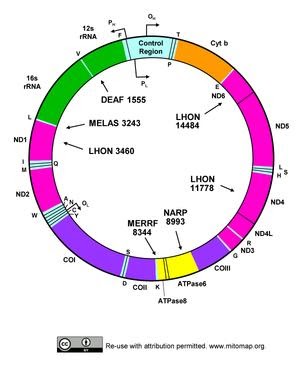
Human Mitochondrial DNA

BY: Ezhuthachan Mithu Mohanan (MIWM043)

DNA within mitochondria was first detected in 1963. Human mitochondria represent the mammalian mtDNA. Human mtDNA is 16,569 bp, double stranded and circular. It codes for 13 polypeptides, belonging to OXPHOS family. mtDNA also codes for 22 tRNA,2 rRNA. It also has control noncoding regions. Various nuclear coded factors also known as precursor polypeptides are essential for the expression and maintenance of mtDNA. It was Sanger who found that circular mtDNA in vertebrates, has both Light Strand and Heavy strand. There are many differences considering nuclear DNA and mitochondrial DNA, which are as follows 

MITOCHONDRIAL DNA NUCLEAR DNA 
Present in mitochondria Present in nucleous
One cell contains 0.25% mtDNAOne cell has 99.75% n DNA
Mutation rate of mtDNA is 20 times faster than nDNASlow mutation rate 
circular Linear
1000’s of mtDNA copies/ cell2 Copies / cell
HaploidDiploid
Maternally inherited Biparental inheritance
Replication repair mechanism is absent Replication repair mechanism is present
Reference sequence by Anderson  and Colleagues in 1981Reference sequence in Human Genome Project in 2001
Size of genome is 16,569 bp Size of genome is 3.2 billion base pair

The genetic code of nuclear DNA differ from mtDNA as such ‘TGA’ codes for tryptophan in vertebrate mitochondria, while it is a stop codon for nuclear DNA. ‘ATA’ codes for Isoleucine in cytosol, while it codes for methionine in mitochondria.

Mitochondrial Inheritance: 

With most of the evidence provided, mostly there is maternal inheritance of mitochondria. Due to nucleotide imbalance and reduction in fidelity of polymerase γ, it causes higher mutation rate. This can be used as approach for human identity test, studying evolutionary and migration pattern.

mtDNA replication:  

Factors for mtDNA  replication: 

DNA Polymerase γ is the polymerase enzyme, it is a heterotrimer with one catalytic subunit ( POLγA). POLγA has 3’-5’ exonuclease activity for proofreading. TWINKLE is DNA Helicase which unwinds double stranded DNA. mtSSB is binds with single stranded DNA to protect from nucleases. Vinograd and coworkers proposed the strand displacement theory, which emphasize continuous DNA synthesis on H and O strand. The replication initiation begins from OH Strand, which proceeds unidirectional. During OL replication stem loop structure is formed which block mtSSB from binding, initiating primer synthesis. Thus the two strand synthesis occur in a continuous manner , until two complete double stranded DNA is formed.A triple-stranded displacement loop structure also known as D Loop is formed, When 7S DNA remains bound to parental L strand, while parental H-Strand is displaced.  The role of mtDNA D loop is not completely understood. 

Mitochondrial Diseases:

A dysfunction in mitochondria leads to mitochondrial disorder. Heteroplasmy  is condition due to presence of mutant mitochondrial DNA .  Various Mitochondrial disorders are as follows:

  1. Mitochondrial Myopathy:  Presence of ragged red muscle fibres is due to accumulation glycogen and neutral lipids which leads to decreased reactivity of cytochrome c oxidase
  2. Leber’s hereditary optic neuropathy : This is maternally inherited, which causes degeneration of retinal ganglion cells
  3. Leigh syndrome: It is a neurometabolic disorder affecting CNS( central nervous system)
  4. Myoneurogenic gastrointestinal encephalopathy : Autosomal recessive disorder. It is due to mutation of TYMP gene
  5. Mitochondrial DNA depletion syndrome: It is also known as Aplers disease. This is caused my mutation inTK2 gene.

MOLECULAR BIOLOGY AND GENETICS

BY: SREELAKSHMI (MSIWM012)

Molecular biology is the study of the chemical and physical structure of biological macromolecules. Genetics is a branch of science dealing with the study of heredity and variation.

 Molecular Biology is an overlapping with other areas of biology and chemistry. It is the understanding of the interactions between DNA, RNA and protein. It is basically of two steps: transcription and translation. It is called Central Dogma. Synthesis of RNA from DNA is called transcription and synthesis of Protein and DNA translation.

TRANSCRIPTION

  • Transcription involves synthesis of new strand of nucleic acid complementary to a DNA template strand.
  • To transcribe a gene, RNA polymerase proceeds through a series of well-defined steps which are grouped into three phases- initiation, elongation and termination.
  • The bacterial core RNA polymerase can initiate transcription at any point on a DNA molecule.
  • RNA polymerase can initiate a new RNA chain on a DNA template and therefore do not require a primer.
  • The elongating polymerase is a processive machine that synthesize and proofreads RNA.
  • Ribonucleotides enters the active site and the added to are growing RNA chain.
  • Termination of transcription is activated by the presence of terminator sequence which results in the elongating polymerase to dissociate from the DNA and release the RNA chain.

TRANSCRIPTION

In eukaryotes, they have three different polymerases and several initiation factors.

TRANSLATION

Translation converts the genetic information present within the mRNA to a linear sequence of amino acids in proteins

The decoding of mRNAs into the language of proteins is composed of four components which are Trna,aminoacyl tRNA synthetasesand also ribosome.mRNa template provides the information that must be interpreted.Aminoacyl Trna synthetase couple amino acids to specific tRNAs that recognize the appropriate codon. The protein coding region of each mRNA have contiguous and non-overlapping string of codon called an open reading frame. Translation starts at 5’end and ends at 3’end.it starts with start codon and ends with a stop codon.AUG is usually a start codon, whereas UAG,UGA,UAA are stop codon.

GENETICS

Genetics is the study of hereditary and variation. The term was first introduced by W Bateson.

Gregor Mendel is known as the Father of Genetics.

Mendel was the first one who told that there are some factors which give you a particular phenotype (eye color, hair texture).The pioneering study on generics was by Mendel on pea plants. He looked at how the size, height, colur.He selected only pure breeds. From result of this experiment he came up with the hypothesis:

  • LAW OF SEGREGATION:

It is studied with the help of monohybrid cross. It states that the alleles of a given locus segregate into separate gametes. It is also called as law of purity.

MONOHYBRID CROSS

  • LAW OF INDEPENDENT ASSORTMENT:

It can be explained with the help of dihydrid cross. Mendel considered seed form and cotyledon color for the cross. This law states that the factors or alleles of each character assort or segregate independent of the factors of other character at the time of gamete formation and get randomly rearranged in the offspring.

DIHYBRID CROSS

POST MENDELIAN

Basics of genetics was given by Mendel, later studies provided information on various genetic interactions which also led to the studies on various genetic disorders.

COMPLEMENTARY GENES

If two genes present on different loci produce the same effect when present alone but interact to form a new trait when present together .They are called complimentary genes.

SUPPLEMENTARY GENES

They are pair of non-allelic genes one of which produces its effect independently in the dominant state.

LINKAGE

It is an exception of principle of independent assortment.

CHROMOSOME THEORY OF LINKAGE

It was given by Morgan and Castle. It states that

  • The genes which show linkage are situated in the same chromosome and remain bounded by chromosomes by material.So,they cannot be separated during the processes
  • The degree or strengthen of linkage depends upon the distance between the linked genes on the chromosomes, closely located genes show strong linkage.
  • Genes lie in linear order in the chromosome.

CROSSING OVER

It is one of the two exceptions of Mendel’s law of independent assortment. It produces new combinations or recombination of genes by interchanging of corresponding segments between non sisters chromatids of homologous chromosomes at prophase 1 of meiosis the non-sister chromatids in which exchange of segments has occurred are called cross overs.