OXIDATIVE AND NON-OXIDATIVE DEAMINATION

INTRODUCTION:

The removal of amino group from the amino acid as ammonia (NH3) is called deamination.

A chemical reaction that is catalysed by the deaminase class of enzymes which results in the liberation of ammonia is called deamination and this liberated ammonia is used for urea synthesis. 

These reactions occur in the liver and kidney of humans. In the kidney, the ammonia which is a result of the conversion of the amine group (that is removed) is excreted from the human body.

Deamination can be either oxidative or non-oxidative.

OXIDATIVE DEAMINATION:

When an amine group is removed from a molecule by the process of oxidation, the reaction is called an oxidative deamination reaction

These types of reactions largely occur in liver and kidney.

These reactions lead to the production of alpha-keto acids etc. via the amine groups.

This reaction is very important in the catabolism of amino acids as it forms a catabolized product from amino acids.

The by-product of this reaction is ammonia which is a toxic. Here, the amine group converts into ammonia. The ammonia that is formed is the transformed in urea which is an excretion product of the body.

Image result for non-oxidative deamination

The primary reactants of such a reaction are glutamic acid or glutamate. This is because usually the end product of most transamination reactions is glutamic acid.

Glutamate dehydrogenase is the enzyme involved that catalyzes the transfer of an amino group to an alpha-keto acid group. 

Another enzyme involved in these reactions is the monoamine oxidase enzyme that catalyzes the deamination via the addition of oxygen.

  • Glutamate dehydrogenase (GDH):

Glutamate dehydrogenase is a mitochondrial enzyme. It also contains the element zinc.

It contains six identical units and has a molecular eight of 56,000 each.

GDH is controlled by allosteric regulation where GTP, ATP, steroid and thyroid hormones inhibit GDH whereas GDP and ADP activate it.

  • Glutamate dehydrogenase and its roles in the process of oxidative deamination:

Glutamate serves as a “collection centre” for amino groups in biological systems because the amino groups of most amino acids are transferred to glutamate.

Rapid oxidative deamination of glutamate leads to the production of ammonia. This is catalysed by glutamate dehydrogenase.

The importance if this GDH catalysed reaction lies within the reversibility of linking up glutamate metabolism with the tricarboxylic acid cycle. This reversibility is credited to the enzyme of alpha-ketoglutarate that is involved.

GDH is unique because it can utilize either NAD+ or NADP+ as a coenzyme.

The intermediate that is formed during the conversion of glutamate to alpha-ketoglutarate is iminoglutarate.

  • Regulation of GDH activity:

The glutamate levels are increased in the body after the consumption of a protein-rich meal and glutamate is converted to alpha-ketoglutarate with the liberation of ammonia.

Further, the degradation of glutamate is increased when the cellular energy levels are low to provide alpha-ketoglutarate which enters the TCA cycle to liberate energy.

  • Process of oxidative deamination by amino acid oxidases:

Alpha-keto acids and ammonia are produced by L-amino acid oxidase and D-amino acid oxidase flavoproteins which possess FMN and FAD respectively.

The result of this reaction is a reduced form of oxygen, which is H2O2

This H2O2 then undergoes a decomposition reaction for which the enzyme is catalase.

L-amino acid oxidase does not act on glycine and dicarboxylic acids and therefore the activity of L-amino acid oxidases is much lower than that of D-amino acid oxidases.

  • Fate of D-amino acids:

D-amino acids are found in plants and microorganisms but are not found in mammalian cells. 

However, they are taken regularly in the diet and metabolised in the body by D-amino acid oxidases to produce respective alpha-keto acids by oxidative deamination.

The first step for the conversion of unnatural D-amino acids to L-amino acids is catalysed by D-amino acid oxidase and is therefore of value within the body.

NON-OXIDATIVE DEAMINATION:

The process of removal of amine groups from a molecule via reactions, all except the oxidation reactions, is called a non-oxidative deamination reaction

The main types of reactions that are involved in this process are: 

1. Reduction

2. Hydrolysis

3. Intramolecular reactions.

However, this reaction also involves the production of toxic by-product ammonia from amino acids. 

Moreover, the most common amino acids that undergo this type of reactions are hydroxy amino acids (serine, threonine, cysteine and histidine), sulphur amino acids (cysteine and homocysteine). Similarly, the most common enzymes involved in this reaction are dehydratases, desulphahydrases, lyase, histidase etc.

The examples of non- oxidative deamination are:

(a) Amino acid hydrases: The hydroxy amino acids undergo deamination by PLP-dependent dehydrases to produce respective alpha-keto acids with the release of ammonia.

(b) Amino acid desulphhydrases: Form keto acids by undergoing a coupled reaction of sulfur amino acids undergoing deamination along with desulphhydration.

DIFFERENCE BETWEEN OXIDATIVE AND NON-OXIDATIVE DEAMINATION:

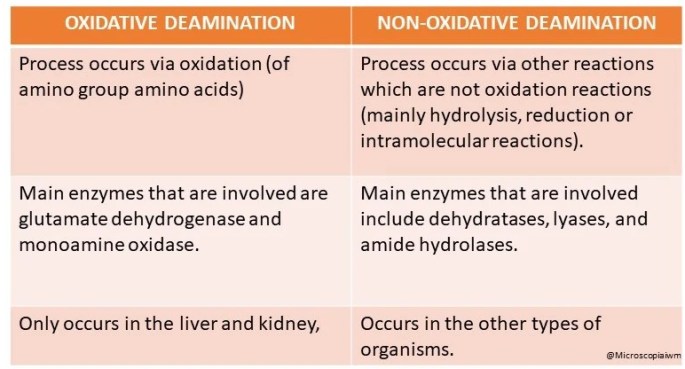
1. Oxidative deamination: Process occurs via oxidation (of amino group amino acids).

2. Non-oxidative deamination: Process occurs via other reactions which are not oxidation reactions (mainly hydrolysis, reduction or intramolecular reactions).

1. Oxidative deamination: Main enzymes that are involved are glutamate dehydrogenase and monoamine oxidase.

2. Non- oxidative deamination: Main enzymes that are involved include dehydratases, lyases, and amide hydrolases.

BY- Shaily Sharma (MSIWM041)
Cholesterol: Sources, Structure and Biosynthesis.

Cholesterol present in the body is derived from dietary foods, hydrolysis of cholesteryl esters and synthesis of cholesterol (more than half of the cholesterol is present due to synthesis).

fig:

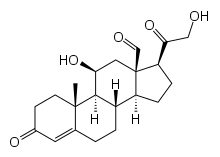
                     Figure: Chemical structure of cholesterol

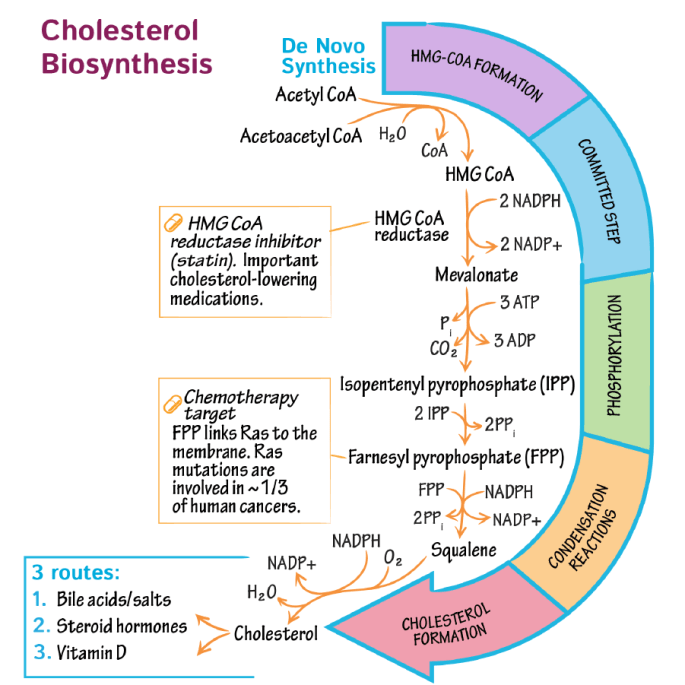
The biosynthesis of cholesterol takes place in the endoplasmic reticulum and the cytosol of the cell. Majorly, the process takes place in nucleated cells of the liver, like hepatic cells. The biosynthesis takes place in 5 major steps:

  1. Biosynthesis of mevalonate:
  • Mevalonate, a conjugate base of mevalonic acid, is formed from acetyl CoA during the synthesis of cholesterol.
  • This takes place in the cytosol of the cell.
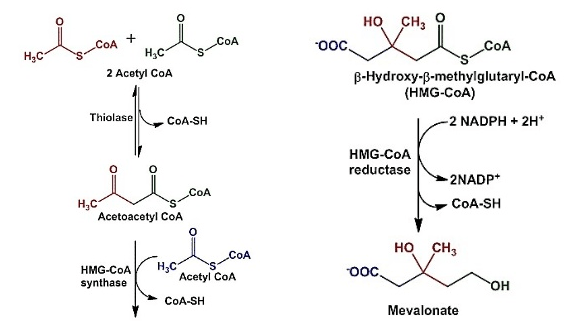
  • Aceto-acetyl CoA is formed by the condensation of 2 molecules of Acetyl CoA, catalyzed by thiolase.
  • This product further condenses with another acetyl CoA molecule to give HMG-CoA, a reaction catalysed by HMG-CoA synthase.
  • This HMG-CoA is reduced to mevalonate by NADPH. This is catalysed by HMG-CoA reductase.
  • This is an important regulatory step as well in the biosynthesis of cholesterol, where HMG-CoA reductase plays a key role.

Figure: Biosynthesis of Mevalonate

  1. Formation of isoprenoid units
  • Isoprenoid units are formed when mevalonate is phosphorylated sequentially in the presence of ATP and Mg2+ and 3 kinases to give mevalonate-3-phospho-5-diphosphate.
  • The final kinase of the phosphorylation, mevalonate-3-phospho-5-diphosphate undergoes decarboxylation to give an active isoprenoid unit.

Figure: Biosynthesis of isoprenoid

  1. Formation of Squalene
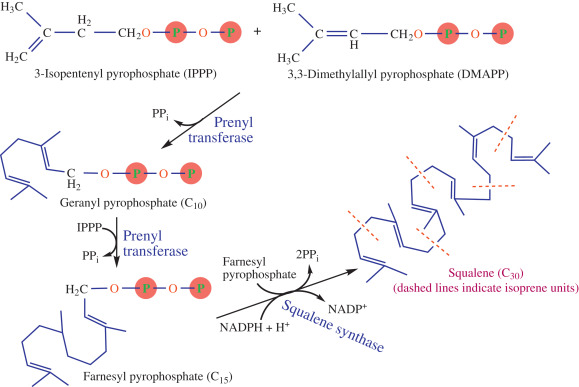
  • Six molecules of Isopentenyl Pyrophosphate (C5) undergo condensation to form a 30 carbon molecule known as Squalene.
  • It is a sequential pathways which proceeds as: C5——>C10——->C15——>C30
  • Intermediates that are observed are geranyl diphosphate (C10), farnesyl diphosphate (C15)  and finally which goes on to form squalene (C30).

Figure: Biosynthesis of Squalene

  1. Formation of Lanosterol
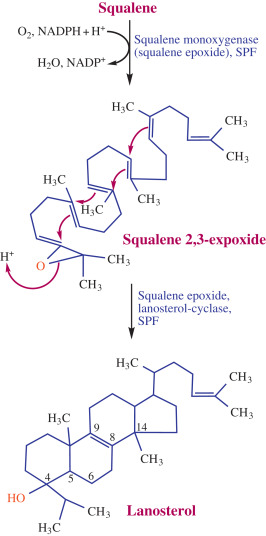
  • Squalene is converted to squalene-2,3-epoxide in the endoplasmic reticulum by squalene epoxidase.
  • After this, ring closure occurs in the presence of oxidosqualene: lanosterol cyclase  to give lanosterol, which is a freshly formed cyclic structure.

Figure: Biosynthesis of Lanosterol

  1. Cholesterol formation
  • Finally, cholesterol is formed from lanosterol in the membranes of the endoplasmic reticulum.
  • This takes place through a number of changes in the side chains and the steroid nucleus.
  • An intermediate known as desmosterol is also formed due to the shift of a double bond.
  • This double bond of the side chain is reduced, which ultimately forms cholesterol.

Figure: Formation if cholesterol from lanosterol

Cholesterol is thus synthesized by nucleated cells in the body through a long pathway involving numerous enzymes and steps. It is an essential molecule as it has various biological functions such as it acts as the precursor for steroid hormones and bile salts, it is required for nerve transmission and is a major constituent of plasma membrane and lipoproteins.

BY- Shaily Sharma (MSIWM041)

MITOCHONDRIA

BY – SREELAKSHMI (MSIWM012)

MITOCHONDRIA

Mitochondria is majorly known as site of metabolism. It was discovered by collier in the flight muscles of insect. Term Fila was given by Fleming and term bio plast was given by Altmen .The term mitochondria was given by Benda.

 It is also called semi-autonomous organelle due its ability to perform certain activities. It is an important organelle in eukaryotes that produce adenosine triphosphate (ATP) which is the energy molecule for the cell. It is also called as the power house of cell. It is believed that mitochondria arises from free-living bacteria which were incorporated into cells.

Generally one mitochondria/cell is observed in unicellular organisms whereas 5 lakhs can be found in the flight muscle cells of insect which is the maximum observed till the date.

Structure of Mitochondria

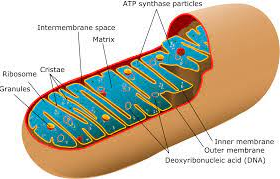
  • Most common shape of mitochondria is disc or oval shape.
  • It have two membranes, an inner and outer membrane, which are made up of phospholipid layers.
  • Outer membrane has less proteins and they are permeable
  • Inner membrane is made up of several folds cristae, which increases the surface area. It also holds many proteins which supports the electron transport chain. It is semi-permeable. Many chemical reactions also take place in inner membrane. The increased surface area enhances the chemical reactions.
  • The inner area of mitochondria which is covered by inner membrane is called matrix. It is reach in enzymes foe cellular respiration and divalent ions like magnesium, ferric ions which are activators of enzyme present in matrix. It contains about 2/3 of total proteins. It is where the ATP production takes place. Space between inner and outer membrane is called perimitochondrial space.
  • Mitochondria have their own generic material and they produce their own RNA and protein. It also contains ribosomes.DNA present in mitochondria is reach in C and G nucleotides which results in the increase of denaturation temperature.
  • Mitochondria contains70s ribosomes .Generally 70s ribosomes are present in prokaryotes and this is the reason why Altman proposed a theory that eukaryotic mitochondria are either prokaryotic in origin or symbiotic.
  • But ribosomes in mammalian cells are 55s type. It has a larger subunit of 38s and smaller subunit of 28s.
  • It contains some nob like structures on cristae and this particles are called oxisomes.

FUNCTIONS OF MITOCHONDRIA

  • Most important function of mitochondria is to produce ATP.The simpler molecules are sent to mitochondria to be converted to ATP molecules. This process is called oxidative phosphorylation.
  • It performs major functions like like oxidation, dehydration, oxidative phosphorylation.
  • It also produces heat and ions of calcium or phosphate.
  • It also helps to maintain proper concentration of calcium ions within the cell compartments.
  •  Helps in building certain parts of blood and hormones
  • Mitochondria play an important role in apoptosis.

MITOCHONDRIAL DISEASE

Every year 1000 to 4000 children are born with mitochondrial disease in US. It is really difficult diagnosed.

In many cases, it is an inherited disease, it can also be due to environmental factors. Mutation in any one of the genes present in mitochondria can lead to mitochondrial disease. The mutation becomes so dangerous that it causes the proteins not to function properly.

This causes the mitochondria not to work properly which results in the decrease in the production of energy. Decrease in energy production can lead to any organ failure or even multiple organ failure.

There is no specific treatment for mitochondrial disease .It’s not having particular symptom or screening method which is the cause for misdiagnosis.

Symptoms can also include poor growth, developmental delays and muscle weakness. Mitochondrial diseases are generally transmitted by mother. Transmission of mitochondrial DNA mutation from mother can be reduced by mitochondrial replacement technique.

It is the replacement of mitochondria one or more cells. This technique uses healthy mitochondria of the donor’s egg. It is an in vito-fertilisatyion on which the mutated mitochondrial genes from mother’s cells is replaced by a third party.

The most common method in mitochondrial donation are maternal spindle fiber transfer using unfertilized egg and pronuclear transfer using fertilized egg. In maternal spindle fiber healthy nucleus of the mother is removed and from the donor egg is taken out without nucleus.

The healthy nucleus of the mother is now transferred to the donor egg and is fertilized. Pronuclear transfer involves the transfer of pronuclei from one zygote to another. It requires the fertilizes egg of donor also.

The healthy nucleus from the fertilized egg of parental couple is taken and the nucleus from donor egg is removed. Now the healthy nucleus is fused with the egg of donor. Mitochondrial disease include

  • Leigh Syndrome: It is a severe neuro disorder which is usually seen children. This leads to the eventual loss of mental and movement abilities. It results in patient’s death within 2-3 years due to respiratory failure. It can be due to the mutation or due to the deficiencies of pyruvate dehydrogenase enzyme. The symptoms also include weakness, muscle spasms. Lack of muscle ton, tremors which are symptoms of various other diseases also .Hence, it is really difficult to diagnose the disease.

METABOLISM

Metabolism: an overview and types

Content:

  • About
  • Catabolism
  • Anabolism
  • Metabolic pathways

About:

  • Metabolism is the collection of chemical reactions takes place to sustain life of an organism.
  • The main purposes of metabolism is to convert food to energy to run cellular activity; to convert food to building blocks for nucleic acids, lipids, protein and carbohydrates; and to remove metabolic waste.
  • The metabolic reactions which are enzyme catalysed are responsible for the growth and reproduction of organism, to maintain their structure and interact with environment.
  • Metabolic reaction is of two types one is catabolic reaction, means the breaking down of compounds and another is anabolic reaction- the building up of the compounds. The catabolic reaction liberates energy and the anabolic reaction uses energy.
  • Metabolic pathways include the steps through which one chemical is transformed into another and each step is facilitating by an enzyme.
  • Enzymes are the key component of the metabolic reaction; they act as catalyst- allows the reaction to proceed more rapidly.

Types:

Metabolic reaction is of two types:

  1. Catabolism
  2. Anabolism

Catabolism:

  • In catabolism the compound through the set of chemical reaction is broken down into simpler compound or molecules.
  • This is achieved by breaking down and oxidizing food molecules.
  • Catabolism is responsible to provide energy for working of the cell and component needed for the anabolic processes which build molecules.
  • The nature of these catabolic reactions based on the source of energy and carbon which is differ from organism to organism.

The chief metabolic processes in a cell are:

  • Glycolysis
  • Pentose-phosphate pathway
  • Entner-doudoroff pathway
  • Tricarboxylic acid cycle
  • Fermentation
  • Glyoxylate cycle
  • Lipid hydrolysis
  • Protein hydrolysis

Anabolism:

  • Anabolism is the set of constructive reactions which used energy released by the catabolic pathway to synthesize complex molecules.
  • The complex molecule construct cellular structure step by step, make up from small and simple precursor.
  • The biomolecules are necessary for the growth and reproduction, some biomolecule serve as the central metabolic intermediates.
  • Some organisms can synthesis all the necessary organic compound like autotrophs. They can be grown on simple media. On the other hand, the organisms which cannot synthesize organic compounds from atmosphere are known as fastidious organisms.
  • Following anabolic process takes place in organism:
  • Synthesis of glucose, lipids, amino acid and protein, nucleic acids
  • Synthesis of other growth factors like vitamins, hormones etc.

Metabolic process:

Glycolysis:

  • In the glycolysis process glucose and other sugar are partially oxidized to the smaller molecule i.e. pyruvate
  • Embden-Myerhof pathway, pentose phosphate pathway and Entner-Doudroff pathway are the three routes for the conversion of sugar into pyruvate.
  • It is anaerobic process in which organism obtain energy in the absence of oxygen, also called anerobic fermentation.

Tricarboxylic acid pathway:

  • Given by H. A. kerbs in 1973
  • Also known as citric acid cycle. Because citric acid is the first product of the kerb cycle which is as known as TCA cycle as the citric acid has three carboxylic group.

Glyoxyalte cycle:

  • It is anaplerotic reaction which means one product of a cycle is taken up by the other cycle
  • Oxaloacetate is taken from TCA cycle and used for carbon source from the amino acid synthesis.

Pentose phosphate pathway:

  • It is an alternative pathway for the sugar degradation.
  • Its main function is to generate power in the form of NADH in extramitochondrial cytoplasm and the second function is to convert hexoses into pentose for the synthesis of the nucleic acids. The third function is complete degradation of pentose.